 FRTOL
UK FRTOL Practical Exam Prep
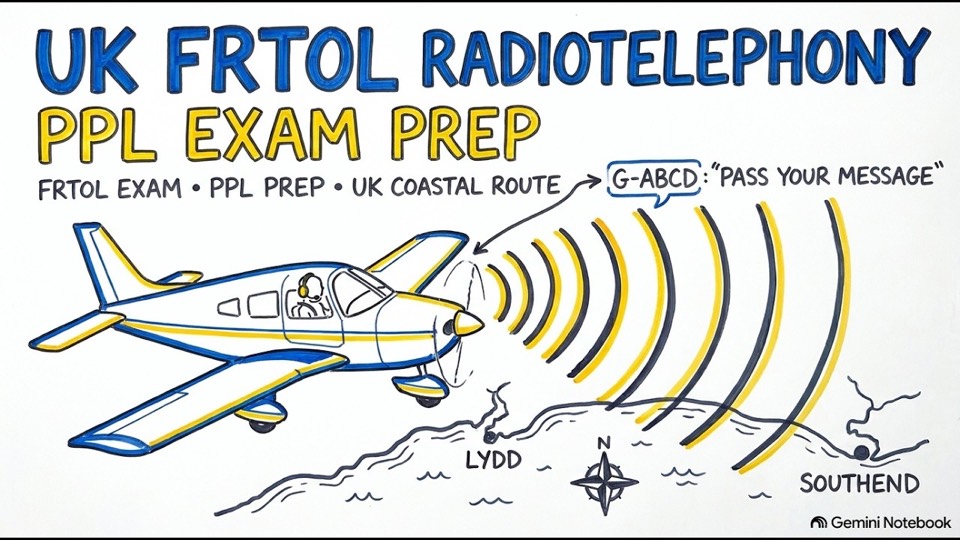
A full radiotelephony training flight along the coast from Lydd to Southend, following CAP 413. Watch it before your test to hear how each call should sound, from the first contact to joining the circuit.
▶ Play the Video01The FRTOL in Brief
In the UK you need a Flight Radiotelephony Operator's Licence (FRTOL) to use an aircraft radio, unless you're under the supervision of someone who holds one. Most pilots get it alongside their PPL or LAPL.
- The written exam is the PPL Communications paper (subject 090). It's usually taken at your flying school, or an RT examiner can set it.
- A practical test pass is valid for 24 months for getting the licence issued.
- There's no extra fee if you apply for the FRTOL together with a PPL or another flight crew licence.
The full requirements are on the CAA's FRTOL page.
Still to sit the theory paper? See the FRTOL written exam guide, with 20 practice questions.
02The Practical Test
The test is a simulated VFR flight. You and the examiner sit in separate rooms and talk only over the radio, as if you were flying solo. The CAA describes it in CAP 2325, Guidance for FRTOL Practical Test Candidates.
Before the Day
- Book an approved RT examiner from the CAA's examiner list (CAP 1585e).
- Have your training signed off on form SRG1171. The examiner needs it.
- Bring photo ID, proof you've passed the Communications exam, a current CAA 1:500,000 VFR chart, chart pens, a ruler and notepaper. Phones and smartwatches aren't allowed.
On the Day
- You're given a route between two aerodromes, chosen on the day and away from where you normally fly.With a flight plan, simulated weather and NOTAMs, and a frequency reference card.
- About 5 minutes to plot the route, then 20 minutes to plan.
- The flight: at least 30 minutes, and up to about an hour.The examiner plays each ground station: an air/ground radio operator, a flight information officer or an air traffic controller.
- Scenario questions, then your result and a debrief.
What It May Include
At least one emergency is always tested, and the call must be made in full and in the right order, without a long pause before you start. Beyond that, the tasks vary, and can come from anywhere in the training syllabus:
- Initial calls and passing your details
- MATZ, ATZ and controlled airspace transits
- Basic and Traffic Services
- Squawks, including frequency-monitoring codes
- Joining: overhead, circuit and direct joins, and SAFETYCOM
- Mayday, Pan and Mayday relay
- Being unsure of your position, a training fix, and 121.5
- Radio failure
You have three attempts. After a second fail more training is required, and the third test is taken with a CAA senior examiner.
Read the full FRTOL practical test guide: a walkthrough of the whole test, call by call, and the common reasons people fail.
03Your Initial Call
Keep the first call short: who you're calling, who you are, and what you want. When the controller says "pass your message", give your details in this order.
Gloster Approach, Golf Juliett Juliett Echo Romeo, request Basic Service.
Golf Juliett Juliett Echo Romeo, Gloster Approach, pass your message.
- Callsign and aircraft type"Golf Juliett Juliett Echo Romeo, PA-28"
- Where from and where to"from Gloucestershire to Oxford"
- Where you are now"five miles south of Gloster"
- Your level"altitude two thousand one hundred feet"
- Anything else: flight rules, intentions, the ATIS letter"VFR, information Juliett"
The service you're given is on the read-back list, so read it back: "Basic Service, Golf Echo Romeo". Shorten your callsign only after the controller does.
04What to Read Back
CAP 413 lists the instructions you must read back in full. Always finish with your callsign. Anything else can be acknowledged more briefly, for example "Wilco, Golf Echo Romeo".
- Taxi instructions
- Level instructions
- Headings
- Speed instructions
- Route clearances
- Approach clearances
- The runway in use
- Clearances to enter, land on, take off from, backtrack, cross or hold short of an active runway
- Squawks and other transponder instructions
- Altimeter settings (QNH, QFE), with units if below 1000 hPa
- VDF information
- Frequency changes
- The type of service
- Transition levels
If you get it wrong, the controller says "negative" and gives the correct version. Read it back again.
Golf Echo Romeo, Basic Service, squawk seven three six three, QNH one zero two two.
Basic Service, squawk seven three six three, Golf Echo Romeo.
Golf Echo Romeo, NEGATIVE, QNH one zero two two.
QNH one zero two two, Golf Echo Romeo.
More standard words and worked examples in our CAP 413 phraseology guide.
05Numbers and Letters
Some digits are said differently on the radio, so they can't be mistaken through static.
| Item | Example | Said as |
|---|---|---|
| Frequencies, digit by digit with "decimal" | 124.175 | one two fower decimal one seven fife |
| Altitudes in whole hundreds or thousands | 2,500 ft | two thousand fife hundred feet |
| Pressure settings | QNH 1013 | QNH one zero one tree |
| Squawks in whole thousands | 7000 | squawk seven thousand |
| Other squawks, digit by digit | 4521 | squawk fower fife two one |
| Headings, always three digits | 045° | heading zero fower fife |
| Flight levels, digit by digit | FL55 | flight level fife fife |
Try any number in the CAP 413 number trainer on our homepage.
The Phonetic Alphabet
Frequencies, squawks, QNH and more in the full aviation phonetic alphabet and numbers guide.
06Mayday and Pan
Use Mayday when you're in serious or imminent danger and need help now. Use Pan Pan when there's a problem with the safety of the flight but you don't need immediate help. At least one emergency is always tested.
Give the Details in This Order
- MAYDAY MAYDAY MAYDAY (or PAN PAN, PAN PAN, PAN PAN)
- The station you're callingUse the frequency you're on. If you're not talking to anyone, call London Centre on 121.5.
- Your callsignAs a solo student, say "student" before it.
- Aircraft type
- The nature of the emergency
- What you intend to do
- Position, level and heading
- Your qualificationsFor example "student pilot", or "no instrument qualification".
- Anything else usefulEndurance, people on board.
| Squawk | Meaning |
|---|---|
| 7700 | Emergency. Set it if you aren't already receiving a service, ideally before the call. |
| 7600 | Radio failure. Transmit twice, starting with "transmitting blind". |
| 7500 | Hijack or other act of violence. |
For a practice, start with "PRACTICE PAN" three times and don't squawk 7700 unless asked. To ask for a training fix, call "TRAINING FIX" three times on 121.5. If you're genuinely lost, make a Pan call instead.
07Flight Information Services
Outside controlled airspace, UK units offer four kinds of service. Ask for one by name, and read back the one you're given.
Basic Service
Information and advice, like weather and airspace activity. Avoiding other traffic is entirely up to you.Traffic Service
The controller tells you about traffic seen on radar. You're still responsible for avoiding it.Deconfliction Service
The controller gives headings or levels to keep you apart from traffic. Not normally for VFR students.Procedural Service
Instructions that separate you from other aircraft on the same service. No information about unknown traffic.The full details are in CAP 774, UK Flight Information Services.
08Official Sources
These guides are a summary. For your exams, always use the current official documents.
These guides and the FRTOL app aren't approved by or affiliated with the UK CAA, and they don't replace your instructor or the official documents. Checked against CAP 413 (edition 24) and CAP 2325 in November 2026.