 FRTOL
UK FRTOL Practical Exam Prep
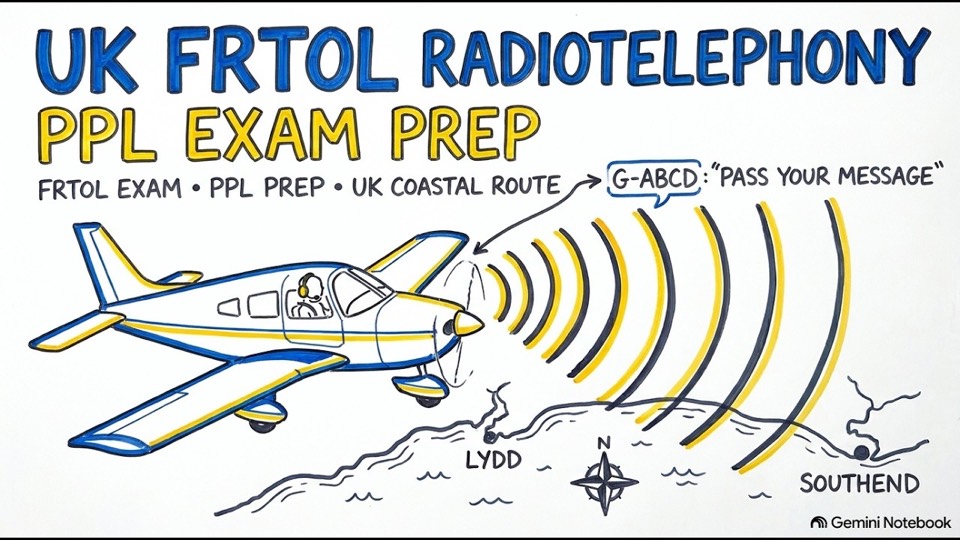
A full radiotelephony training flight along the coast from Lydd to Southend, following CAP 413. Watch it before your test to hear how each call should sound, from the first contact to joining the circuit.
▶ Play the Video01What the FRTOL Practical Test Is
The FRTOL practical test is the spoken half of the UK Flight Radiotelephony Operator's Licence. It checks that you can use an aircraft radio safely and with standard phraseology. You don't fly anywhere: it's a simulated VFR flight, done entirely over the radio.
It's conducted by an approved RT examiner (the CAA calls them FRTOL Examiners). You and the examiner sit in separate rooms with radio equipment the examiner provides, so you hear each other only through the headset, just as you would in the air. You play a licensed pilot flying solo in a serviceable aircraft with a radio and a transponder with altitude reporting. The examiner plays every station you talk to: an air/ground radio operator, a flight information service officer or an air traffic controller, and stays in that role for the whole flight.
The route runs between two aerodromes with at least one turning point. It's picked on the day, away from where you normally fly, and the airfield information is generic, so local knowledge won't help. It isn't a navigation test, but you do need to read a VFR chart.
02What You Need Before Booking
Get these in place first. Without them, the examiner can't start the test, or the CAA can't issue the licence.
- The written Communications exam, passed. It must be done before the practical test. If you haven't sat it yet, see our guide to the FRTOL written exam.
- Form SRG1171, signed. This is the Flight Radiotelephony training syllabus and training record, not the licence application. Whoever ran your RT training at your ATO or DTO signs it to confirm you've covered the syllabus. It's mandatory for every candidate, and you hand it to the examiner before the test starts.
- Real practice on a radio. You must have used two-way radio equipment in training, either in the aircraft or in a simulated set-up.
- English Language Proficiency at level 4 or above, valid on the date the licence is issued.
- Age. You must be at least 14 to hold the licence.
After you pass, the licence itself is applied for online on form SRG1105. There's no extra fee if you apply for the FRTOL at the same time as your PPL or LAPL. A practical test pass counts for licence issue for 24 months.
03Booking, Cost and the Day Itself
You book the test yourself, directly with an examiner. Your flying school can usually recommend one, and the CAA publishes the full list as CAP 1585e, the RT examiner list.
The cost varies between examiners, so check when you book.
How the Day Runs
- ID and paperwork checksPhoto ID, your signed SRG1171 and proof of your Communications pass.
- The standard CAA candidate briefThe test formally starts here. From this point it ends in a pass, a fail or a discontinued test.
- The route is revealed, and you get about 5 minutes to plot it
- A route and test brief, then 20 minutes of planningYou're given a flight plan, simulated weather and NOTAMs, a frequency card and the RTF Aide Memoire. The notes you make here can be used in the flight.
- The flightAt least 30 minutes, up to about an hour.
- Scenario questions, then your result and a debrief
04A Typical Test Flight, Call by Call
No two tests are the same, but most flights follow a familiar shape. Here's an example using the callsign G-JJER and a fictional unit called Gloster. All frequencies and codes here are made up.
1. Radio Check
Say who you're calling, who you are, and the frequency. The reply uses the readability scale, where 5 is perfectly readable.
Gloster Tower, Golf Juliett Juliett Echo Romeo, radio check one one ait decimal fife two fife.
Golf Juliett Juliett Echo Romeo, Gloster Tower, readability fife.
2. Departure Information and Taxi
Tell the controller you have the current ATIS letter, so they don't have to read it out. Runway, QNH and taxi instructions all need reading back.
Gloster Tower, Golf Juliett Juliett Echo Romeo, PA-28 at the flying club, VFR to Newbridge, information Charlie, request taxi.
Golf Echo Romeo, taxi holding point Alpha, runway two seven, QNH one zero one fower.
Taxi holding point Alpha, runway two seven, QNH one zero one fower, Golf Echo Romeo.
3. Changing to an En-Route Service
Once clear of the aerodrome, you'll often move to London Information, the flight information service run from the London centre. It gives a Basic Service: information such as weather and airspace activity, with avoiding other traffic left to you. Read back the service you're given.
London Information, Golf Juliett Juliett Echo Romeo, request Basic Service.
Golf Juliett Juliett Echo Romeo, London Information, pass your message.
Golf Juliett Juliett Echo Romeo, PA-28, from Gloster to Newbridge, ten miles east of Gloster, altitude two thousand three hundred feet, VFR, request Basic Service.
Golf Echo Romeo, Basic Service, Cotswold one zero one one.
Basic Service, Cotswold one zero one one, Golf Echo Romeo.
The order of those details matters. Our guide to making your initial call sets it out step by step, and the four UK flight information services are explained there too.
4. Position Reports
When asked, or at the points on your plan, give your position, the time, your level, and your next point with an estimate.
Golf Echo Romeo, Hillford, time fower fife, altitude two thousand three hundred feet, estimating Newbridge one fife.
5. Controlled Airspace or a MATZ
Expect at least one call to cross someone else's airspace: a control zone, an ATZ or a military zone. Ask early, and never enter until you're cleared. Every part of the clearance that limits your route or level must be read back.
Golf Echo Romeo, squawk fower fife two one, cleared to cross the Gloster control zone from Hillford to the reservoir, VFR, not above altitude two thousand feet, QNH one zero one fower.
Squawk fower fife two one, cleared to cross from Hillford to the reservoir, VFR, QNH one zero one fower, Golf Echo Romeo.
Golf Echo Romeo, NEGATIVE, not above altitude two thousand feet.
Not above altitude two thousand feet, Golf Echo Romeo.
6. The Emergency
The examiner tells you in the brief how you'll be alerted, then at some point steps out of role to give you a problem, such as a rough-running engine. The CAA guarantees only that there'll be at least one. Decide whether it's a Mayday (serious and/or imminent danger, immediate help needed) or a Pan (urgent, but no immediate help needed), and start the call without undue delay: the CAA treats a pause of more than 30 seconds as too long.
Pan Pan, Pan Pan, Pan Pan, London Information, Golf Juliett Juliett Echo Romeo, PA-28, rough-running engine, intend to divert to Newbridge, fifteen miles east of Gloster, altitude two thousand three hundred feet, heading zero niner zero, PPL, no instrument qualification, one person on board.
Golf Juliett Juliett Echo Romeo, London Information, roger Pan, report reaching Newbridge.
The call must be complete and in the right order. Learn the sequence cold with our Mayday and Pan call order. The emergency stays live until the examiner tells you it's over, so carry on flying it, and cancel the call when the problem is resolved.
7. Rejoin and Circuit
At the destination, expect an initial call to the aerodrome, the airfield information or ATIS, and a join: overhead, downwind, base or straight in.
Golf Echo Romeo, join overhead, runway two fower, left-hand circuit, QFE niner niner ait hectopascals.
Join overhead, runway two fower, left-hand, QFE niner niner ait hectopascals, Golf Echo Romeo.
Golf Echo Romeo, downwind.
Golf Echo Romeo, final.
Pressure settings below 1000 hPa are read back with the units, as above. Other tasks you might meet include a Traffic Service, frequency-monitoring squawks, SAFETYCOM at an unattended airfield, being unsure of your position, or a radio failure.
05What RT Examiners Look For
The test isn't about sounding slick. The examiner wants to hear that you're safe, standard and clear, on every call.
- Read-backs of safety items. Clearances, levels, headings, runways, squawks, pressure settings, frequencies and the type of service. Our list of what to read back covers them all.
- Correct callsign use. Your full callsign on first contact, shortened only after the ground station does it, and at the end of every read-back.
- Standard phraseology. The words from CAP 413, not your own version of them. Our CAP 413 phraseology guide explains the common phrases, and the aviation phonetic alphabet and numbers guide covers how to say letters and digits.
- Structure. Details given in the expected order, especially on initial calls, position reports and the emergency.
- Situational awareness. Knowing where you are, which frequency you're on and who you're talking to, asking for crossings in good time, and noticing when an instruction doesn't fit.
06Common Reasons People Fail
Most fails come from a few habits that are easy to fix with practice out loud.
- An incomplete or jumbled emergency call. Missing an item, getting the order wrong, or choosing Pan when the situation calls for Mayday.
- Hesitating too long before the emergency call.
- Missing a read-back, particularly a level restriction or a pressure setting buried in a long clearance.
- Entering airspace without a clearance, or treating "standby" as permission.
- Shortening the callsign before the ground station does.
- Non-standard words, like "repeat" for "say again", or chatty additions that clutter a call.
- Losing the picture: calling the wrong station after a frequency change, or forgetting the service you're under.
The examiner explains exactly why and puts any further training in writing. You have three attempts, each on a different route. After a second fail, more training is mandatory, and the CAA nominates a senior examiner for the third test.
07Kit and Preparation Checklist
Bring on the Day
- Photo ID, such as a passport or driving licence
- Your completed, signed form SRG1171
- Evidence of your Communications exam pass
- A current CAA 1:500,000 VFR chart for the region you've agreed
- Chart pens and a ruler
- Notepaper and a pen
Leave your phone and smartwatch outside: no device that can communicate or record is allowed in the room. If you've failed before, also bring the failure report (form SRG2129) and any extra training record.
In the Weeks Before
- Say every call out loud, not in your head
- Drill the Mayday and Pan order until it's automatic
- Practise long clearances and their read-backs
- Plot and plan a route on a chart in 25 minutes
- Read the CAA's candidate guidance, CAP 2325
- Fly a full mock test with someone playing ATC
You can practise with the FRTOL RT exam app, which plays the controller, checks your read-backs and runs examiner-style mock exams with a debrief. It's a training aid, not approved by or affiliated with the UK CAA, and it doesn't replace your instructor or the real test.
08FRTOL Practical Test Questions
How long is the FRTOL practical test?
The simulated flight lasts at least 30 minutes and up to about an hour. Add the briefing, around 5 minutes to plot the route, 20 minutes of planning time, scenario questions and the debrief, and most people should allow a good part of a morning or afternoon. Check the timings with your examiner.
Do I have to pass the written exam before the practical test?
Yes. The PPL Communications written exam must be passed before you sit the practical test, and you show the examiner evidence of the pass on the day.
Is there always an emergency in the FRTOL practical test?
Yes, at least one. The examiner tells you during the brief how you will be alerted. You must then make the call in full and in the correct order without undue delay. Other tasks vary from test to test.
Can I take my own notes or aide memoire into the test?
You can use the notes you make during the 20 minutes of planning time, and the RTF Aide Memoire the examiner gives you. No other aide memoire is allowed, and phones and smartwatches are not permitted in the room.
What happens if I fail the FRTOL practical test?
The examiner explains why and records any further training needed. You are entitled to three attempts, each on a different route. After a second fail, more training is mandatory, and the CAA nominates a senior examiner for the third test.
How long is a practical test pass valid?
The practical test must have been passed within the 24 months before the licence is issued. Once issued, the FRTOL is valid for life, as long as your English Language Proficiency stays valid.
09Official Sources
This guide is a summary. For your test, always use the current official documents and your examiner's brief.
This guide and the FRTOL app aren't approved by or affiliated with the UK CAA, and they don't replace your instructor, your examiner or the official documents. Checked against CAP 413 (edition 24) and CAP 2325 in November 2026.